Showing posts with label IP Law. Show all posts

08 December 2017

To patent, or not to patent. . .

For most of us on the Western Slope, the topic of patents is pretty dull.


Yet, from the iPhone to e-cigarettes; aspirin to airplanes, all these great inventions we love and loath are the product of inventors, innovators, and entrepreneurs, who, in exchange for sharing the technology with the public, are granted a monopoly (patent) over the invention for a limited number of years, usually twenty.

Patents allow inventors to recoup the cost of research and development and to be able to make a profit from their hard work. Strong patents rights also have a consumer benefit. When competitors are blocked from copying and flooding the market with cheap knock-offs, it means real innovation has to occur in order to avoid infringement. If a copycat is merely tweaking, society’s knowledge base isn’t being expanded.

US Supreme Court hear 90 minutes of arguments in
Oil States v. Greene on Nov. 27, 2017. Matt Soper photo.
On Monday, Nov. 27th, the U.S. Supreme Court heard oral arguments in Oil States Energy v. Greene's Energy, a case which could drastically change whether an inventor opts to patent new technology, or, like the Coca-Cola recipe, keep it as a trade secret.

The legal question is fairly simple: whether patents are property rights, like land or cars, or whether they are public rights, similar to a marriage licence, driver’s licence, or licence to practice medicine.

If patents are held to be property rights, then only a Federal Court has the power to take that property away from its owner. If the Supreme Court decides patents are akin to licences, then the U.S. Patent & Trademark Office (PTO), as an administrative agency, may invalidate the patent at any time after its been issued.

Let’s say you have spent thousands of dollars and hours researching and developing an invention, then several thousands more in attorney and PTO fees, and then, after a cumbersome multi-year process of examination against prior art, the PTO finally issues you a patent. With this patent you build a business and hopefully are successful. At this point in time, you aren’t going to take too kindly to the Patent Trial and Appeals Board within the PTO accepting a petition to review the validity of your patent, especially since the Board doesn’t afford parties the same due process and procedural protections as courts.

The America Invents Act 2011, among other reforms, created the Inter Partes Review (IPR) process for administratively reviewing the validity of issued patents.

Congress created IPR on the presumption that the PTO had issued too many bad or weak patents over the years. Patent trolls take these “bad patents” and assert frivolous lawsuits with the goal of scaring the end user into a settlement. IPR was designed to make challenging bad patents cheaper and faster. However, as of Jan. 2018, it will cost a petitioner $30,500 to initiate an IPR and the patent owner will spend at least $300,000 defending the patent.

Instead of juries determining whether a patent was nonobvious or novel, Congress moved this determining process to the PTO – an executive agency. Such a change also meant patents were no longer treated as property and presumed valid, unless proven otherwise, but instead, IPR treats issued patents as if they are still in the application process.

Currently, roughly 75% of patents subjected to the IPR process are declared invalid. The losing party may appeal to the D.C.-based Court of Appeals for the Federal Circuit (CAFC). However, CAFC has only reversed 10% of the PTO’s IPR decisions.

The Court's liberal justices appeared to voiced support for IPR. Justice Sonia Sotomayor noted during oral arguments that the ability to appeal “saved” the IPR system.

Colorado’s-own Justice Neil Gorsuch questioned the fairness of a system that could allow a government agency to take property after it had been granted.

Conservatives on the Court seemed concerned about the government’s ability to void patents too easily.

The fact that an overwhelming majority of patents subjected to IPR are revoked and CAFC acts as a rubber stamp for the PTO means small businesses and micro inventors are discouraged from pursuing and developing patented technology.

This author believes issued patents are vested rights that should only be taken away through a court of law and not via an administrative board.

A decision is expected in June 2018.


* Matt Soper, a legal scholar, is a CMU alumnus and resident of Delta, Colo. He holds law degrees from the Universities of Edinburgh and New Hampshire. Contact him at matt.soper@alumni.law.unh.edu

_________________________________
Matthew Soper, "To patent, or not to patent." Grand Junction Daily Sentinel (Dec. 3, 2017) p. B5.

16 September 2017

Unified Patent Court question illustrates complexity of Brexit, Europe & the EU

Rare are the times that intellectual property questions sneak into the conversation of a major Brookings Institution, who were discussing, “Europe and the U.S.: The old order faces a new world,” in front of a live audience and the nation, via C-SPAN, were hit with a very specific, “in the weeds” type question from one audience member. “When can we expect to see the [European] Uniform Patent Court treaty ratified and why is Germany holding up the process?” The panel of experts made a good faith attempt at an answer, but admitted their knowledge in this particular area was limited. After the question was addressed, a sea of diplomats, lawyers, academics, and scholars in the audience could be seen googling “Uniform Patent Court.”
European Patent 0080627B1
Opening & closing for retractable fountain pen nib
25 Feb. 1987 European Patent Office
Washington think tank. Experts at the

The UPC may not be sexy like Brexit, Russia, or China in terms of US – European wonk talk, but the entangled mess is worthy of analysis, because it is directly related to Brexit, domestic state parochialism, harmonization of patents, and a developing a more integrated EU.

In June 2017, a complaint was submitted to Germany’s Constitutional Court, asking the court for an einstweilige Anordnung, to temporarily enjoin the ratification of the German Unified Patent Court Agreement Act. At the request of the court, the Office of the Federal President agreed to suspend the ratification process until a decision on the merits has been rendered by the court.

The complaint was submitted by Düsseldorf IP lawyer Ingve Björn Stjerna, and alleges a violation of the right to democracy, "democratic deficits and deficits in rule of law with regard to the regulatory powers of the organs of the UPC", "perceived lack of an independent judiciary under the UPC", and non-conformance of the UPC with EU law.

At the end of August 2017, the Federal Constitutional Court “invited the German Government, the German Bar Association and the European Patent Lawyers' Association to provide observations in response,” according to Lexology.

As of 15 September 2017, there is still no indication on a timeline for resolving the stay of ratification. Germany is an essential element for the UPC to come into force, as the treaty requires at least 13 EU states ratify the UPC under their domestic constitutional framework, plus the three largest patent filing states at the time of adoption. Those three states, as of 19 February 2013, were France, Germany, and the UK.

Courts for resolving patent disputes will be in France, Germany, and the UK, along with regional courts in other states. The registry and court of appeals will be located in Luxembourg.

In contrast to Germany, the UK did ratify acts which pave the way for the UPC to come into force, however, in navigating its exit from the EU, the UK has to make the case that the Unified Patent Court is the product of an independent treaty and not an EU institution. According to BNA, the May Government has said Brexit will end the Court of Justice of the European Union’s “direct legal authority” over the UK. On 23 August 2017, the UK government released a position paper which emphasised that parties to international treaties commonly agree to submit disputes to a non-state court.


The future of the European Patent Court is an analogy for the future of Europe; a complex web of rules, state sovereignty, Brexit, pressure from international business, and a general lack of leadership to define a future and pursue it. The experts at Brookings should rest assured that the question they were posed is one that even constitutional judges in Germany are having a difficult time answering. 

16 May 2016

Are the regional university naming wars over?

Remember a few years ago, three and a half to be exact, when the names “University of Western Colorado” and “Western Colorado University” were the source of tremendous tension between Colorado Mesa University and Gunnison’s Western State Colorado University?
The 2011 row began when then-Mesa State College surveyed alumni, students, staff, and the community and found the name “University of Western Colorado” to be the No. 1 choice for renaming Mesa.
Western State’s Board of Trustees, worried about name confusion, immediately passed a resolution opposing any Colorado based institution of higher education using the words “western” or “west” in its name.
Mesa acquiesced to Western’s demands and choose the fourth most popular name from the survey — Colorado Mesa University.
Immediately after legislation was signed by Gov. John Hickenlooper which officially renamed Mesa State College to CMU, Western State College began exploring rebranding and adding the word university to their name too.
A Western survey found “University of Western Colorado” and “Western Colorado University” to be the most popular names. However, CMU President Tim Foster, in a Feb. 8, 2012 letter to Western’s board wrote, “two of the names in your survey continue to pose a problem both from a brand perception and confusion standpoint. In our most recent Board of Trustees meeting, the Board asked again that you avoid the names University of Western Colorado and Western Colorado University.”
In the end, opposition and political maneuvering resulted in neither institution using the survey popular names.
While CMU may have won the battle by playing tit-for-tat in the 2011-2012 university naming skirmishes, ultimately WSCU will win the war.
In January 2016, WSCU was issued a notice of allowance, by the United States Patent and Trademark Office (USPTO), to use the names “University of Western Colorado” and “Western Colorado University.” The trademark rights were issued without any party objecting to or opposing the names during the posted opposition period. In April 2016, WSCU filed an extension, rather than filing a statement of use. The Gunnison institution has three years to develop a UWC or WCU brand, so they can file a statement of use, or let the marks die.
Did WSCU manage to pull a fast one on CMU? The Gunnison Country Times recently quoted WSCU officials as saying the university is not pursuing a name change to align with the newly acquired trademarks.
This type of comment by WSCU officials makes the bona fide intent to use the trademark very fishy. If WSCU’s intent is really just to hold the name, but not use it, then they are ordinary squatters, along with defrauding the public.
Unfortunately for CMU, the USPTO takes declarants on their face value, unless it is highly suspicious. Because it is plausible that WSCU could have a bona fide intent to change to “University of Western Colorado” or “Western Colorado University” down the road — or — an intention to use that mark as a sub-brand for something else on campus, the USPTO will let it go.
So far, no local legislators have been formally asked to carry name changing legislation for WSCU, so taking those clever Mountaineers at their word, let’s assume they are telling the truth to everyone. WSCU could actually develop a UWC or WCU brand which is different from their legal name.
In the business world it is common for a brand name to be different from the legal name of the business. Why not pursue a similar strategy in the academic world? This would be a stroke of genius, as after using their new brand name, WSCU could ask the Colorado General Assembly for a legal change to match their trademark. If the legislators or the governor said no, that would be OK, as WSCU could continue business under their trade name.
Ultimately, WSCU gets the names “University of Western Colorado” and “Western Colorado University,” which is why CMU not only lost to WSCU’s earliest demands, but the tit-for-tat measure was merely a reprisal delaying the inevitable loss.
In the broader picture, the delay and CMU’s non-opposer status, created a cease fire that has endured long enough for everyone’s tempers to subside, passions to ebb, and the possibility of a new brand identity to emerge that will result in a more peaceful and psychologically acceptable result for the parties.
WSCU holds a very powerful hand of cards right now and it will be fascinating to see which direction the university chooses to head.
The author, a CMU alumnus, served two terms as student trustee. Contact him at m.c.soper@ed-alumni.net.
______________________________________
M Soper, "Are the regional university naming wars over?" The Daily Sentinel (Grand Junction, Colo.) 15 May 2016 print. online. accessed 16 May 2016.

12 February 2014

Hickenlooper's new trademark more than just a beer coaster

This past summer, Gov. John Hickenlooper unveiled a new ‘trianglized-licence plate looking’ trademark to market the State of Colorado nationwide and overseas. More recently, State Rep. Bob Rankin (R-Glenwood Springs), introduced legislation to have the people decide whether they want a new logo for Colorado.

Colorado's new federally registered trademark
A week ago, H.B. 1017 was killed by the Democrats, on a party line vote, in the House Business, Labor, Economic and Workforce Development Committee.

Rep. Rankin fell short of promulgating the negative legal consequences Hickenlooper’s new trademark may have on Colorado businesses. To begin, we need to first understand some basics of American trademark law.
 
A trademark is a word or phrase, logo, or other graphic symbol used by a manufacturer or seller to distinguish its product or products from others in the market place. The main purpose of a trademark is to designate the source of goods or services. Therefore, a trademark is something that only exists with respect to some commercial activity.

Trademarks can take one of three forms: standard character format; stylized/design format; or sound mark. For example, the word: “Coke” is a standard character mark, which means any style or symbol with the word “Coke” is protected under the Lanham Trademark Act of 1946. The Coke bottle-logo is a good example of a stylized/design mark. And yes, the roar of the Harley-Davidson engine is a protected sound mark.

When federally registering marks with the United States Patent and Trademark Office, a class of goods or services must be indicated. Going back to the “Coke” example, the Coca-Cola Company has registered the use of the Coke mark on everything from clothing to toys to food and drink products.

A quick search of the USPTO shows that Hickenlooper’s trademark is registered as a standard character mark, which means that the trademark owner has an obligation to pursue any individual or entity that uses the words: “CO” or “Colorado” on any “Clothing, namely, tee shirts, sweat shirts, polo's, hats, and jackets.”

In layman’s terms, Hickenlooper has successfully stifled private businesses in Colorado who make a living putting the word “Colorado” on a t-shirt and selling it to tourists. In other words, the state is now a direct competitor in the intellectual property arena with Colorado businesses.

In order to avoid open licencing, the State of Colorado will be forced to send hundreds of cease-and-desist-letters to small business across this state who dare infringe upon the state’s intellectual property right.

The second registered class which Hickenlooper is claiming is for “promoting public awareness about Colorado itself, and public services offered through Colorado state government entities, as well as promoting products and services originating from Colorado businesses and organizations.” Here, the state may have a legitimate interest, but the question still remains, why are they claiming a mountain of rights, when they really on need a hill?

The USPTO search also revealed the registered owner is not listed as the State of Colorado, but as Brand Colorado, a division of Colorado Nonprofit Development Center, which is located in Boulder. Shouldn’t the trademark owner be an actual state entity, such as the Colorado Tourism Office?

The Hickenlooper Administration’s effort to replace the Colorado State flag and seal with a trendier brand/trademark circumvents the reason for emblems of state. The current state trademarks – the flag and seal – identify and distinguish the source of state services / goods for the public. Additionally, each agency has its own trademark to indicate to the public the services they offer.

Creating more official trademarks to represent the State of Colorado blurs the distinction of which trademark represents, which is the source of the services. In other words, more marks confuse the public about which one actually represents the State of Colorado.

This past summer I was at the US Open Tennis Championships in New York and saw a man with a ball cap and Colorado flag on it. I asked him if he was from Colorado, as it is always great to see fellow Coloradoans when outside the state. He told me he had just spent a week holidaying in Aspen and thought we had a really cool flag design. Perhaps this New Yorker was not the target of the new trademark marketing campaign.

During my time in Edinburgh, Scotland, it was quite common to see tourists with stylized Colorado gear, mostly an artistic version of the red “C” with fields of blue and white. Of perhaps all the states, Colorado has one of most iconic and memorable flag-trademarks and adding a new mark only serves to block intellectual property fields which should be in the hands of the private sector.


Adding a new trianglized-licence plate looking trademark to the state’s intellectual property portfolio only serves to confuse the general public on which mark actually represents the State of Colorado. Additionally, Hickenlooper’s mark fails the state’s real objective, which is to market the state to tourists, businesses, and investors. 

30 August 2013

New Colorado Trademark

Hickenlooper's new Colorado logo
The Hickenloop Administration’s effort to replace the Colorado State flag and seal with a trendier brand / trademark circumvents the reason for emblems of state. The current state trademarks – the flag and seal – identify and distinguish the source of state services / goods for the public.

Creating more official trademarks to represent the State of Colorado blurs the distinction of which logo /
mark represents which source. In other words, more marks confuse the public about which one actually represents the State of Colorado.


Yesterday I was at the US Open Tennis Championships in New York and saw a man with a ball cap and Colorado flag on it. I asked him if he was from Colorado, as it is always great to see fellow Coloradoans when outside the state. He told me he had just spent a week holidaying in Aspen and thought we had a really cool flag design.

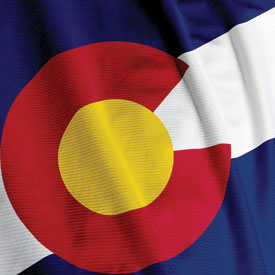
Colorado state flag
When I saw the red “C” with yellow circle and two strips of blue on a field of white I knew that mark represented Colorado. I also knew it represented the State of Colorado and if I saw the flat on letter head, I’d pay close attention. Adding a new trianglized-licence plate looking trademark to the state’s intellectual property portfolio only serves to confuse the general public and fails the state’s real objective, which is to market the state to tourists, businesses, and investors. 

20 February 2013

Legal implications: Did J.K. Rowling misrepresent her nationality to U.S. Copyright Office?

Dame J.K. Rowling accepts an award from The University of Edinburgh
Chancellor, HRH The Princess Royal

Harry Potter author J.K. Rowling misrepresented her nationality and/or domicile status when she registered her book, Harry Potter and the sorceror’s stone (Reg. No. TX0004879549, Sup. TX0005164406), with the U.S. Copyright Office on 1 October 1998. Ms. Rowling indicated that her nationality or domicile status was the United States. The Business Insider (quoting The Times) quotes J.K. Rowling as saying:
 “I chose to remain a domiciled taxpayer for a couple of reasons. The main one was that I wanted my children to grow up where I grew up, to have proper roots in a culture as old and magnificent as Britain’s; to be citizens, with everything that implies, of a real country, not free-floating ex-pats, living in the limbo of some tax haven and associating only with the children of similarly greedy tax exiles.
 A second reason, however, was that I am indebted to the British welfare state; the very one that Mr Cameron would like to replace with charity handouts. (sic) When my life hit rock bottom, that safety net, threadbare though it had become under John Major’s Government, was there to break the fall. I cannot help feeling, therefore, that it would have been contemptible to scarper for the West Indies at the first sniff of a seven-figure royalty cheque. This, if you like, is my notion of patriotism.”

A simple Google search also gives prima facie evidence that Ms. Rowling has not been granted American citizenship, nor was she domiciled in the United States in 1998. It seems bizarre that Ms. Rowling, a former French-English teacher would commit fraud on her copyright registration form. Any reasons, ranging from intent to negligence, would be merely speculative.

What is the legal effect of an error on a copyright registration? More specifically, how would such an error, whether intentional or not, impact an action for copyright infringement in the U.S. federal courts?

The general rule is found in § 411(a) of the U.S. Copyright Act (1976), which took effect on 1 January 1978:
 “[N]o civil action for infringement of the copyright in any United States work shall be instituted until preregistration or registration of the copyright claim has been made in accordance with this title. In any case, however, where the deposit, application, and fee required for registration have been delivered to the Copyright Office in proper form and registration has been refused, the applicant is entitled to institute a civil action for infringement if notice thereof, with a copy of the complaint, is served on the Register of Copyrights.”

An “immaterial, inadvertent errors in an application for copyright registration do not jeopardize the validity of the registration.” Data General Corporation v. Grumman Systems Support Corporation, 36 F.3d 1147, 1161 (1st Cir.1994); see Automated Solutions Corp. v. Paragon Data Systems, Inc., No. 1:05 CV 1519, 2008 WL 2404972 (N.D.Ohio June 11, 2008).

U.S. federal courts have exclusive original jurisdiction over actions arising under the federal copyright laws. 28 U.S.C. § 1338(a). An action “arises under” copyright laws, “if the complaint is for a remedy expressly granted by the [U.S. Copyright] Act [(1976)], . . . or asserts a claim requiring construction of the Act . . . or, at the very least and perhaps more doubtfully, presents a case where a distinctive policy of the Act requires that federal principles control the disposition of the claim.” T.B. Harms Co. v. Eliscu, 339 F.2d 823, 828 (2d Cir.1964), cert. denied, 381 U.S. 915, 85 S.Ct. 1534, 14 L.Ed.2d 435(1965).

JK Rowland's US Copyright registration which indicates
 her citizenship is: USA. (click picture to enlarge)
For example, “[m]istakes such as an incorrect date of creation or failure to list all co-authors easily qualify as immaterial because the Copyright Office's decision to issue a certificate would not be affected by them.” Torres–Negron v. J & N Records, LLC, 504 F.3d 151, 158 (1st Cir.2007) (citing Data Gen. Corp., 36 F.3d at 1163). “[W]here a plaintiff's registration was procured through fraud . . . the registration becomes invalid and the courts lack jurisdiction over the case.” Id. at 162.

This means that registration, involving material errors, fraud, or an incomplete application, nullifies the U.S. federal court's subject matter jurisdiction. 17 U.S.C.A. § 411(a).

Does the fact that Ms. Rowling’s copyright registration contains an error as to her nationality affect her ability to claim remedies expressly granted by the U.S. Copyright Act? The answer is no, as that is an error in the application which did not affect the Copyright Office’s decision to issue a certificate of copyright. A material error would be fraud, in which J.K. Rowling had asserted ownership over a work in which she was not the author, owner, agent, or exclusive licensee. This was certainly not the case with Harry Potter and the sorceror’s stone. Copyright registration is a presumption of ownership. A presumption is subject to rebuttal. The main premise of the formality of registration is the presumption of ownership.

Whilst Ms. Rowling’s nationality and/or domicile is factually inaccurate on the copyright registration, that error does not affect the presumption for which copyright registration is sought.  

18 January 2012

Is censorship without due process like security checks without probable cause?


Is the pursuit of safety worth relinquishing essential liberty? Civil liberties are being eroded at an alarmingly fast rate. Newspapers have been filled with examples of human rights being trampled in the name of protection and security. 

Wikipedia, Reddit, and approximately 7,000 smaller websites recently coordinated service blackouts to protest the Stop Online Piracy Act (SOPA) and PROTECT IP Act (PIPA) which were being voted on in the US Congress. The bills would have given law enforcement the ability to protect digital private property rights by blocking web content which might violate US law. The legislation would have threatened the 1st Amendment right of free speech and allowed the federal government to censor certain websites without due process of law.

America’s government has lulled its citizens into a false sense of security. Flying is no longer merely about traveling from one city to another, but involves queuing for what feels like ages, placing all liquids of three ounces or less into quart sized bags, and stripping shoes, coats, and belts, along with all other loose objects, into a tray for scanning. This is followed next by the preverbal walk through the metal detector and/or body-scanner, and for the ‘lucky’ few – full body pat down by a Transportation Security Administration (TSA) officer. For those refusing, they get the Rand Paul treatment. Flying in the ‘free world’ has become an expo of liberty in derogation.

Al-Qaeda has single-handedly eroded our essential liberty by giving governments a tool to prey on citizens - FEAR. In the name of security and safety, our government has chosen the means by which to protect us, the people, from terrorists. Fear has led to a proliferation of the “security industrial complex”.

The rise of the military [security] industrial complex: A recent report out of the UK put the Homeland Security Industry at a global market valuation of nearly $200 billion per annum. Despite the killing of al-Qaeda CEO, Osama bin Laden, economic woes and growing national debts, aren’t holding governments back on funding counter-terror activities. People have begrudgingly said government knows best and accepted a world with security checks, surveillance systems, and restrictions on travel and personal effects.

In spite of our government’s efforts, are we safer today than we were prior to September 11, 2001? The Department of Homeland Security can cite numerous cases of would be terrorists who have been disrupted in their plot to harm Americans. The Justice Department has deported, extradited, or tried dozens of terrorists. Yet, through all these interventions and billions of dollars spent both at home and abroad, America is as much at risk today as it was eleven years ago. The 9-11 Commission Report points out measures were in place to impede such attacks; however, an ‘infallible’ bureaucracy failed to react timely to overt indications of threats.

The most important change since 9-11 has been the securing of the cockpit door to prevent turning a plane into a ‘guided missile’. Studies have shown if terrorists cannot enter the cockpit and take control of the plane, then the worst damage they can inflict is bodily harm to passengers or blowing up the plane. People who become victims have a right of self-defence and tend to react if life and limb are in imminent threat. The best example is United Airlines flight 93, where the passengers reacted to the suicide hijacking by rushing the cockpit. The most lethal weapons in the war on terror is individual people, everyday heroes, not a government willing to use fear to erode personal freedoms and liberties.

The only way to stop the proliferation of the ‘security industrial complex’ is to stop feeding it! I want a leader who isn’t afraid to admit our government has lulled us into a false sense of security. I’d rather accept the risks of freedom, and have more freedom than the protection of an overreaching, ineffective and ever centralized bureaucracy.