Showing posts with label John Hickenlooper. Show all posts

07 May 2014

Beauprez’s anti-gun past may come to haunt him

When asked about the Second Amendment, Bob Beauprez has a tendency of only talking about Governor John Hickenlooper’s policies.

So what about Bob?

A mere 14 years ago, Beauprez and and former Governor Bill Ritter were on the Amendment 22 band
Bob Beauprez flip-flops on 2nd Amendment.
wagon, which was a state-wide referendum calling for special restrictions for gun shows. These included an instant background check for certain sales that take place at a gun show, even if not required had the same sale occurred not at the gun show.

Amendment 22 passed with 70 percent of the vote.

During the 2006 contest between Beauprez and Ritter; Beauprez claimed Ritter loved gun control, whereas he supported the Second Amendment. This claim was the basis of one of the Both-ways-Bob ads which mocked Beauprez for flip-flopping on the Second Amendment.

The Independence Institute defended Beauprez’s mistake, by claiming the error was due to poor journalism by the Denver Post.

However, going back a bit further, when Beauprez was Colorado Republican State Chairman, he sent out a letter to GOP legislators calling for the party uniting on new gun control laws in the aftermath of the Columbine Shooting.

At the time, Rocky Mountain Gun Owners responded to the message by saying, “Gun rights supporters are told, in essence, to sit down, shut up, and take their medicine.”

Beauprez constantly called for closing the “loopholes in our gun laws.” The Owens Administration, working with Chairman Beauprez, crafted legislation to reign-in gun shows, proposed mandatory gun locks, and moved to disarm Coloradoans between the ages of 18 and 21.

Even Congressman Tom Tancredo voted for an assault weapons ban and a ban on magazines, along with making a few incriminating statements after the school shooting.  

The strategy, in the wake of Columbine, was to compromise a little on gun control, in order to maintain control of all three branches of state government. The results of the 2000 General Election saw the Republicans lose the State Senate to the Democrats.

The question now turns, has Beauprez become a hard-line Second Amendment kind of guy?

Recently, the question of gun control arose during an Aspen gathering. Aspen is not necessarily the friendliest of towns for gun advocates. Beauprez, playing to the audience said, if elected, and if a (gun control) repeal comes to me, I’d sign it.

Beauprez further stated that people with mental illnesses shouldn’t have easy access to guns.

Sounds a bit like the old Beauprez?

Perhaps compromising on some aspects makes political sense in some areas of strategy, but once you go down the road of giving an inch, before you know it, you’ve given a mile.

To be fair to Beauprez, he has claimed that a propensity to commit crime must be an element of limiting the Constitutional rights of someone who is mentally ill.

If society knew who had a propensity to commit a crime before a crime occurred, then why wouldn’t we create a pre-crimes police force, as illustrated in the film Minority Report to stop all evils before they occur?

Beauprez has also failed to define who would be legally classified as mentally ill? Does one visit to a psychologist mean a citizen could be pre-empted from their Second Amendment rights?

Prior to endorsing Beauprez this week, State Senator Greg Brophy, had declared both Beauprez and Tancredo weak on the Second Amendment. Yet in his endorsement, Brophy steered clear of gun talk, saying Beauprez had the best odds of winning.

Perhaps being soft on the Second Amendment is the key to winning the even-split urban-7th Congressional District twice, but for voters in rural Colorado the difference between the incumbent and Beauprez regarding gun control is a shady haze of grey.

All hope is not lost.

Republicans Mike Kopp and Scott Gessler, both have served America in the Army and both believe the Second Amendment is a right not to be compromised.

The Rocky Mountain Gun Owners feels the same way and has given Kopp and Gessler the two-thumbs-up.


Defeating Hickenlooper will be tough, but victory only comes if there is a candidate who can draw distinctions, not blur the differences over key policy issues, such as the Second Amendment. 

___________________
Matthew Soper, Letter to the Editor, Beauprez’s past may come back to haunt him, Delta County Independent, May 21, 2014, at A2.


Matthew Soper, Letter to the Editor, Beauprez evaluated on the Second Amendment, Gunnison Country Times, May 21, 2014, at A14.

12 February 2014

Hickenlooper's new trademark more than just a beer coaster

This past summer, Gov. John Hickenlooper unveiled a new ‘trianglized-licence plate looking’ trademark to market the State of Colorado nationwide and overseas. More recently, State Rep. Bob Rankin (R-Glenwood Springs), introduced legislation to have the people decide whether they want a new logo for Colorado.

Colorado's new federally registered trademark
A week ago, H.B. 1017 was killed by the Democrats, on a party line vote, in the House Business, Labor, Economic and Workforce Development Committee.

Rep. Rankin fell short of promulgating the negative legal consequences Hickenlooper’s new trademark may have on Colorado businesses. To begin, we need to first understand some basics of American trademark law.
 
A trademark is a word or phrase, logo, or other graphic symbol used by a manufacturer or seller to distinguish its product or products from others in the market place. The main purpose of a trademark is to designate the source of goods or services. Therefore, a trademark is something that only exists with respect to some commercial activity.

Trademarks can take one of three forms: standard character format; stylized/design format; or sound mark. For example, the word: “Coke” is a standard character mark, which means any style or symbol with the word “Coke” is protected under the Lanham Trademark Act of 1946. The Coke bottle-logo is a good example of a stylized/design mark. And yes, the roar of the Harley-Davidson engine is a protected sound mark.

When federally registering marks with the United States Patent and Trademark Office, a class of goods or services must be indicated. Going back to the “Coke” example, the Coca-Cola Company has registered the use of the Coke mark on everything from clothing to toys to food and drink products.

A quick search of the USPTO shows that Hickenlooper’s trademark is registered as a standard character mark, which means that the trademark owner has an obligation to pursue any individual or entity that uses the words: “CO” or “Colorado” on any “Clothing, namely, tee shirts, sweat shirts, polo's, hats, and jackets.”

In layman’s terms, Hickenlooper has successfully stifled private businesses in Colorado who make a living putting the word “Colorado” on a t-shirt and selling it to tourists. In other words, the state is now a direct competitor in the intellectual property arena with Colorado businesses.

In order to avoid open licencing, the State of Colorado will be forced to send hundreds of cease-and-desist-letters to small business across this state who dare infringe upon the state’s intellectual property right.

The second registered class which Hickenlooper is claiming is for “promoting public awareness about Colorado itself, and public services offered through Colorado state government entities, as well as promoting products and services originating from Colorado businesses and organizations.” Here, the state may have a legitimate interest, but the question still remains, why are they claiming a mountain of rights, when they really on need a hill?

The USPTO search also revealed the registered owner is not listed as the State of Colorado, but as Brand Colorado, a division of Colorado Nonprofit Development Center, which is located in Boulder. Shouldn’t the trademark owner be an actual state entity, such as the Colorado Tourism Office?

The Hickenlooper Administration’s effort to replace the Colorado State flag and seal with a trendier brand/trademark circumvents the reason for emblems of state. The current state trademarks – the flag and seal – identify and distinguish the source of state services / goods for the public. Additionally, each agency has its own trademark to indicate to the public the services they offer.

Creating more official trademarks to represent the State of Colorado blurs the distinction of which trademark represents, which is the source of the services. In other words, more marks confuse the public about which one actually represents the State of Colorado.

This past summer I was at the US Open Tennis Championships in New York and saw a man with a ball cap and Colorado flag on it. I asked him if he was from Colorado, as it is always great to see fellow Coloradoans when outside the state. He told me he had just spent a week holidaying in Aspen and thought we had a really cool flag design. Perhaps this New Yorker was not the target of the new trademark marketing campaign.

During my time in Edinburgh, Scotland, it was quite common to see tourists with stylized Colorado gear, mostly an artistic version of the red “C” with fields of blue and white. Of perhaps all the states, Colorado has one of most iconic and memorable flag-trademarks and adding a new mark only serves to block intellectual property fields which should be in the hands of the private sector.


Adding a new trianglized-licence plate looking trademark to the state’s intellectual property portfolio only serves to confuse the general public on which mark actually represents the State of Colorado. Additionally, Hickenlooper’s mark fails the state’s real objective, which is to market the state to tourists, businesses, and investors. 

30 August 2013

New Colorado Trademark

Hickenlooper's new Colorado logo
The Hickenloop Administration’s effort to replace the Colorado State flag and seal with a trendier brand / trademark circumvents the reason for emblems of state. The current state trademarks – the flag and seal – identify and distinguish the source of state services / goods for the public.

Creating more official trademarks to represent the State of Colorado blurs the distinction of which logo /
mark represents which source. In other words, more marks confuse the public about which one actually represents the State of Colorado.


Yesterday I was at the US Open Tennis Championships in New York and saw a man with a ball cap and Colorado flag on it. I asked him if he was from Colorado, as it is always great to see fellow Coloradoans when outside the state. He told me he had just spent a week holidaying in Aspen and thought we had a really cool flag design.

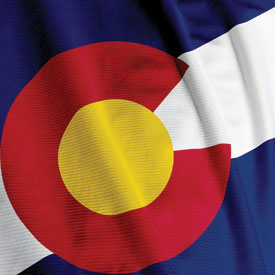
Colorado state flag
When I saw the red “C” with yellow circle and two strips of blue on a field of white I knew that mark represented Colorado. I also knew it represented the State of Colorado and if I saw the flat on letter head, I’d pay close attention. Adding a new trianglized-licence plate looking trademark to the state’s intellectual property portfolio only serves to confuse the general public and fails the state’s real objective, which is to market the state to tourists, businesses, and investors. 

18 March 2013

Hickenlooper signs Syrian-style-gun-control measures

With Governor Hickenlooper's signature to HB 1224 and HB 1229 it looks like indeed the pen is mightier
than the sword/gun. The government now has the carte blanche ability to restrict any firearm which uses a magazine (this is due in part to the hastily drafted language in the bill). This is an assault on all of Colorado, our state and national constitutions, and natural law. Our peaceful protests in halls of power have been ignored. It is time the people stand up to the grievous and al-Assad-like assaults on our liberties!

As in the pre-Arab-Spring-era, the unchecked power of the Syrian Ba’ath Party also stripped their citizens of firearms. Syrian Legislative Decree No. 51 of 23 September 2001 banned private ownership of semi-automatic military looking rifles, revoking rifle permits, and only allowing permits for single shot-pistols and single-shot hunting rifles of low-calibre. Currently the people of Syria are in a bloody civil war in which the government of Bashar al-Assad is trying to quell resistance to the majority elected, single party rule.

In the Democratic controlled legislature, Colorado – like Syria – passed universal background checks, which require background checks of the possessor of a firearm when the owner is away for more than 72 hours. Along with blurring the lines of possession and ownership, the legislature completely ignored the vast majority of Colorado’s sheriffs, including Delta County’s own Fred McKee, who testified in Denver against HB 1229. With the new legislation in Colorado, as in Syria, private sales of firearms will be essentially prohibited.

The Democrats won’t achieve universal registration, universal licencing, and third-party liability this legislative session, but given another future-mass-shooting somewhere in the nation, these Syrian policies can be expected if freedom minded legislators and governors are not elected.

No one party should ever control all three branches of government. Yet when the Democrats rolled into power they began catering to the whims of the masses which has resulted in short-sighted, rights-restricting, and oppressive policies. It is time to petition Governor Hickenlooper for a redress of these grievances and upon denial demonstrate that the people of rural Colorado will openly and respectfully defy these anti-constitutional gun control measures.
_____________________________________________
*M Soper, LTE / OpEd, Mountain Valley News. 27 March 2013  http://www.mountainvalleynews.net/index.php/home/3-opinion/3910-letters-to-the-editor-32713.html accessed 27 March 2013

10 May 2011

New Era at CMU will build on Mesa State legacy

Over the last eight years, Mesa State College has grown from a student population of 5,000 to pushing 10,000 with annual enrolment percentages in the double digits! Mesa State has gone from competing against state colleges within Colorado for students to now attracting students who otherwise would be attending major public institutions like the University of Colorado System, the University of California System and the University of Texas System.


The local economy greatly depends on the fresh influx of dollars which students from outside the western slope bring to the Grand Valley. The future of Mesa’s success will depend on more students from out-of-state and overseas subsidising the cuts to higher education from the legislature. A strategic name change is one step towards mitigating future negative impacts on the success of recent years.

Like many stakeholders with vested interests in the continued future success of Mesa State College, I was surprised in the name selected. It seemed the top four choices (none of which were considered by the Board of Trustees) from the stakeholder surveys would have been more natural. The tripartite test established by the college merited only one logical choice – Colorado Mesa University. My first impression was that the new name sounded weird. It seems a lauded educational institution should stand on its own merit without the crutch of a 150 year old state/territory name tacked onto the front.

It’s too bad Mesa didn't have a name like Harvard, as then the only change could have been replacing the word ‘college’ for ‘university’. Though, ‘Massachusetts Harvard University’ would have merited similar thoughts as expressed above.

The brand name of ‘Colorado’ is very powerful and as Governor Hickenlooper signs the legislative approved ‘Colorado Mesa University’ into law, a new era will begin. As expressed by the Sentinel’s Editorial Board – it’s time to get use to CMU (not Carnegie Mellon University). Confusion is sure to abound in the ensuing three to five years, as entity names such as ‘Colorado MESA’ (Mathematics, Engineering, Science and Achievement) is distinguished from ‘Colorado Mesa’ and recruiters explain CMU is the new MSC. One confusing point is certainly eliminated; future students will no longer mistake our ‘Mesa’ with Arizona’s or California’s Mesa Colleges.

As the dawning of the new future is here, Colorado Mesa University will be standing on the shoulders of a great educational legacy (gigantium humeris insidentes). A legacy I am proud to have been a part of as having served two terms on the College’s Board of Trustees.[1]

______________________________________________________
[1] M Soper, 'New Era at CMU will build on Mesa State legacy' (Grand Junction Daily Sentinel: 13 May 2011); http://www.gjsentinel.com/opinion/articles/e-mail-letters-may-13-2011; accessed 14 May 2011